PunchM – The Central Punchlist Management Software
The Central Punchlist Tracking & Management Software
PunchM (Punchlist Management Software) is a comprehensive module for managing, organising and resolving issues, snags, defects and punch lists at different stages of the project. By providing detailed descriptions (with system number & name), assigning the defect to the executer, and tracking the progress of defects to closure, the PunchM (Punchlist Management Software) platform makes it easier for System Owners & Project Managers to follow the progress until successful completion. Proof of work completion can be easily attached from the phone. Sort issues by systems and create easy reports
Improve communications, enhance accountability, ensure traceability and increase productivity
PunchM – Track every punch item from issue to closure.
Define – Organise – Finish
Our Pillars
DEFINE
- Initiate snags, defects and punch lists online
- Define priority or category
- Assign the works directly to the executer
- Define expectations for closure
- Schedule completion date
ORGANISE
- Track updates and status in real-time
- Manage activities as per the systems
- Effortlessly monitor/report the status
- Resolve issues/bottlenecks online & on-time
- Monitor efficiencies
FINISH
- Route for approval online
- Upload all proof for closure
- Maintain all updates centrally
- Support continuous improvement
- Manage remotely and across boundaries
- Support data-driven decisions making
Challenges & Solutions
Potential quality and safety issues due to an insecure defect management system
Secure process online: Streamline teams, provide secured access and set project priority to complete defects on-time
Lack of real-time data to identify bottlenecks and eliminate risks
Encourage active collaboration – Support active risk management by providing secure global access to teams to update status 24 X 7
Extensive coordination process from lack of prioritisation of defects
Define the Priority – Define the requirements and assign defects to the respective executor, cut-out middleman & minimise delay
Repetitive failures and schedule delays due to insufficient verification of satisfactory closure
Upload proof of completion – Approvals are required by System Owner / Project Manager to confirm the closure of defects.
Highlights
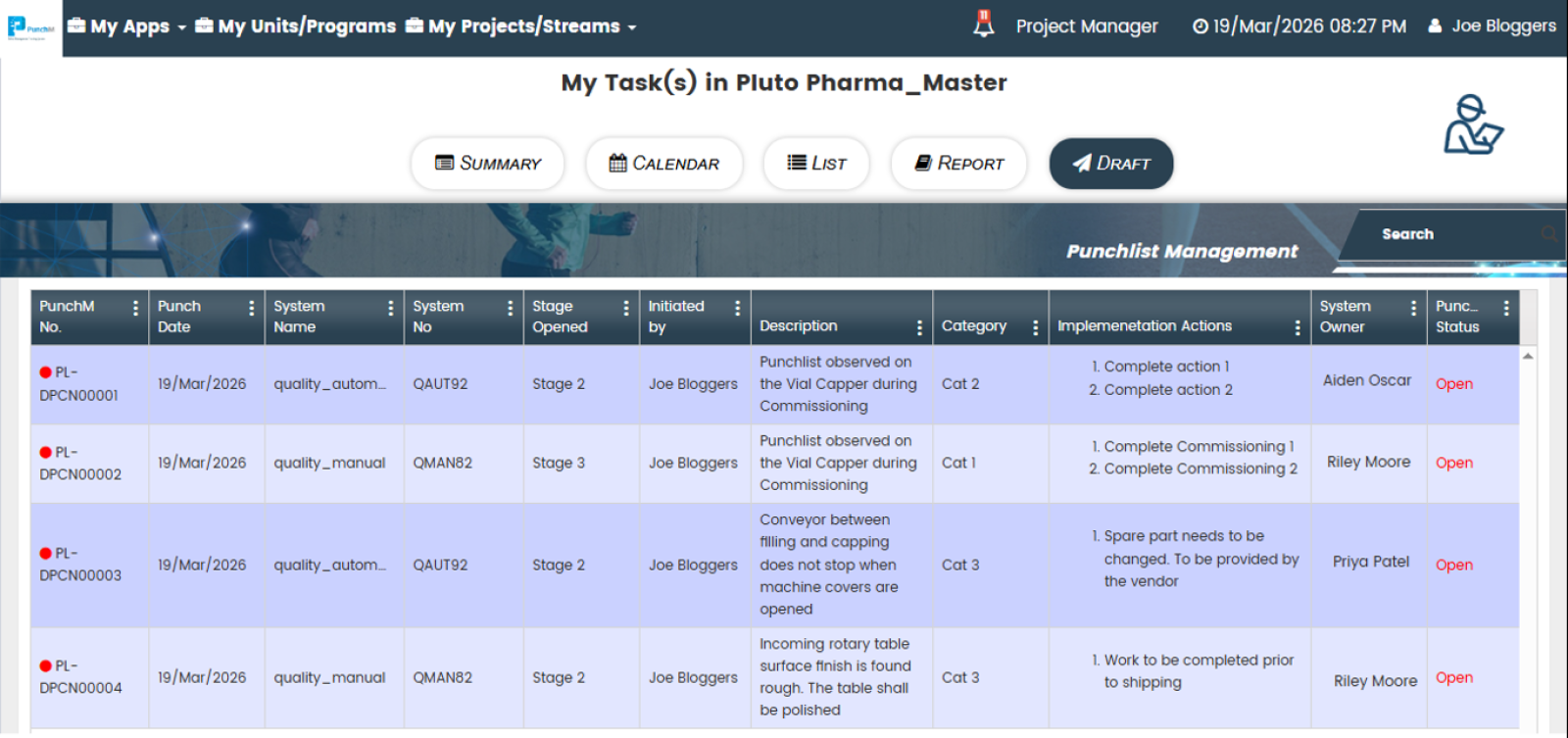
Draft View
Keep incomplete records in Draft—nothing gets lost.
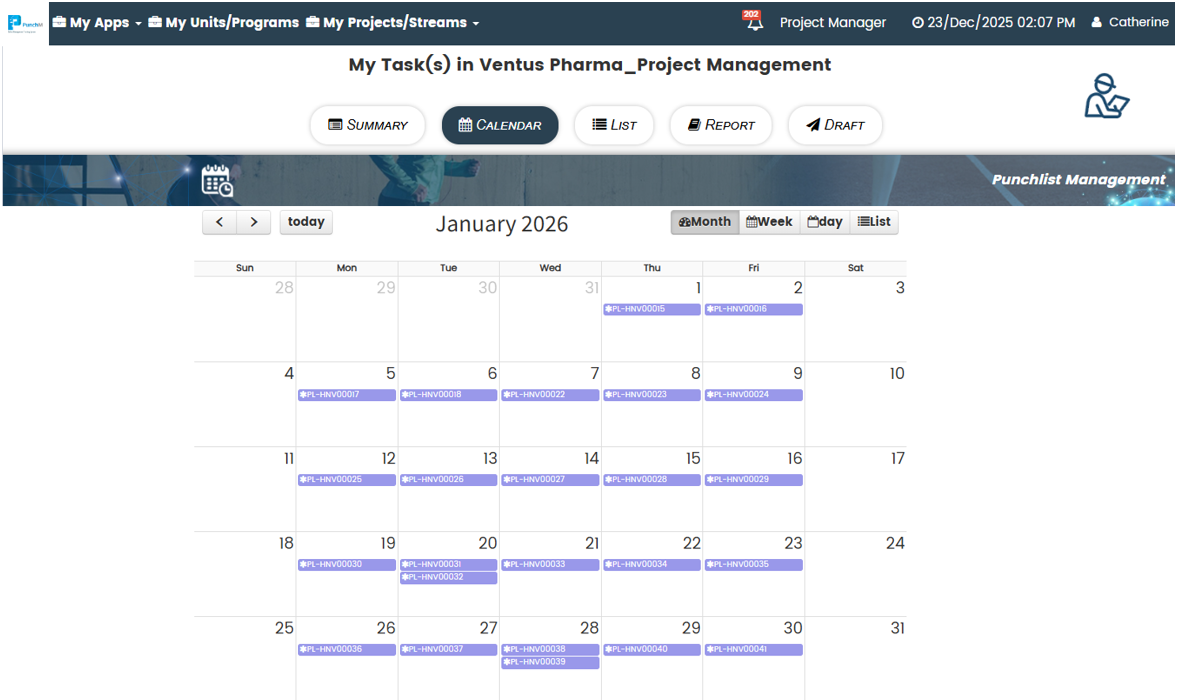
Plan using Calendar View
Plan and keep up with your project schedule to close your punchlist on time.
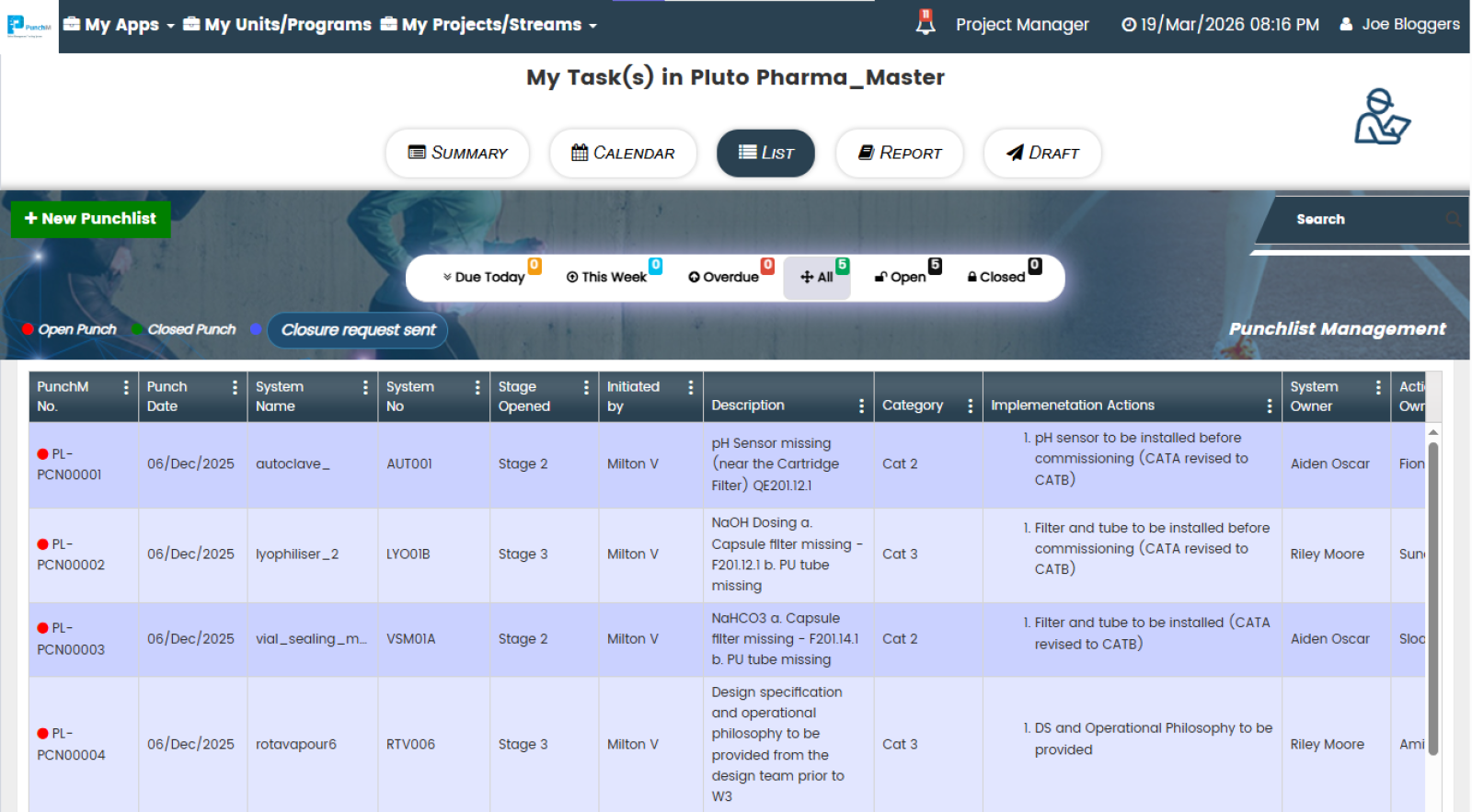
List View
Get a detailed view of all the Punchlist and easily sort by systems/dates etc.
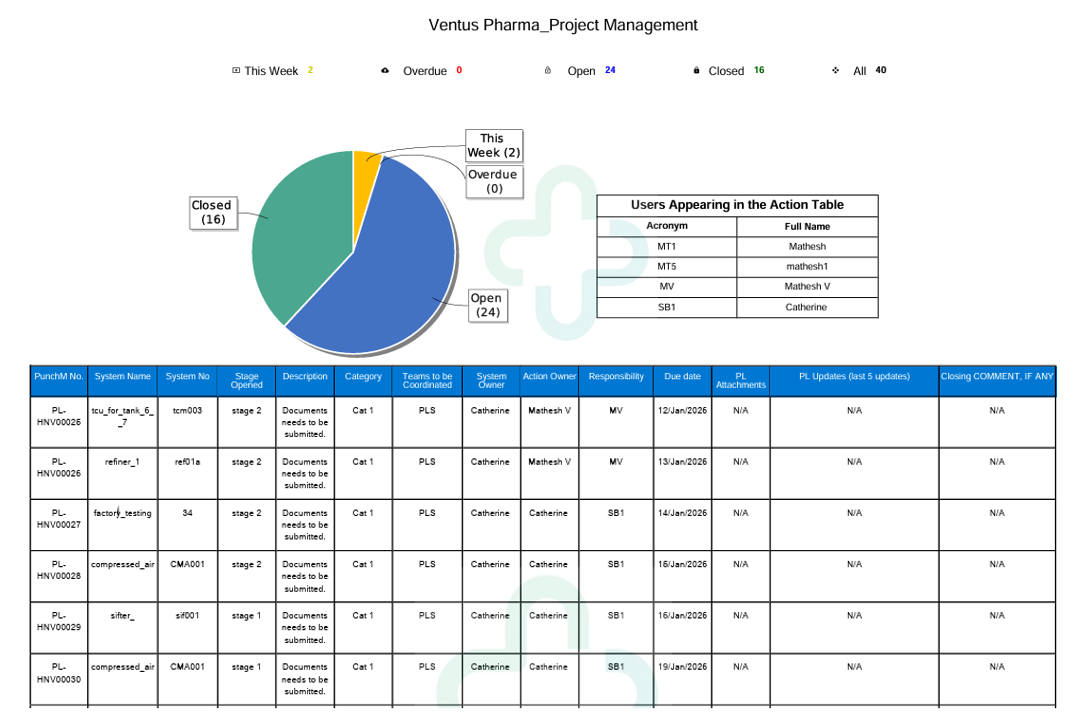
Customised Reports
Easily sort and create customised reports and export them to pdf or excel formats.
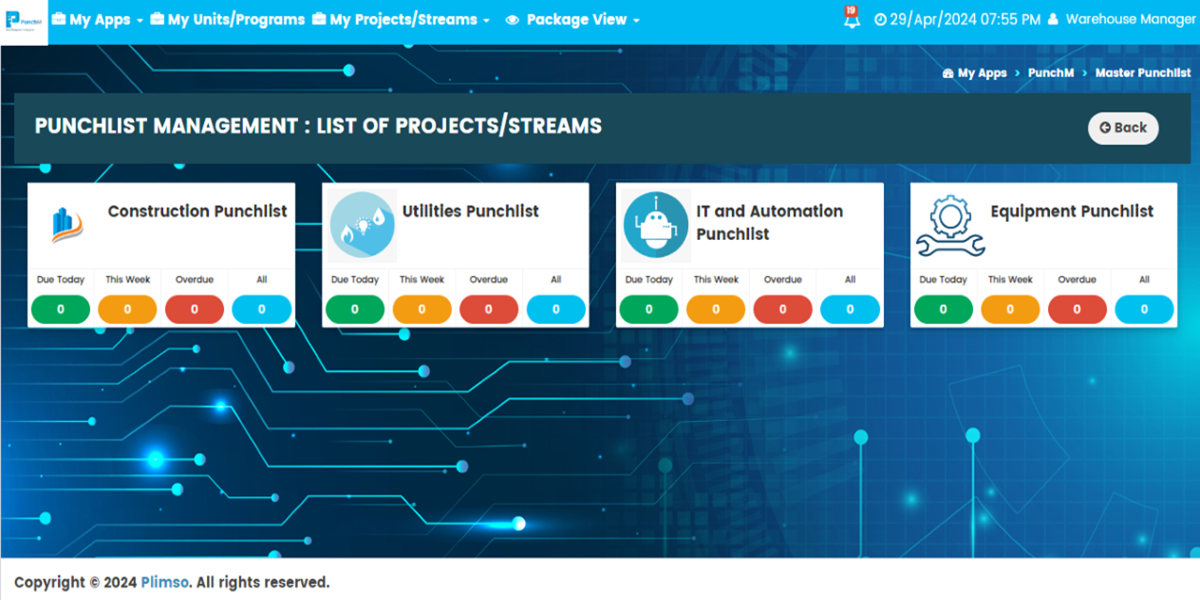
Business Units / Programs
Centrally manage Punchlists from different Business Units/Programs.
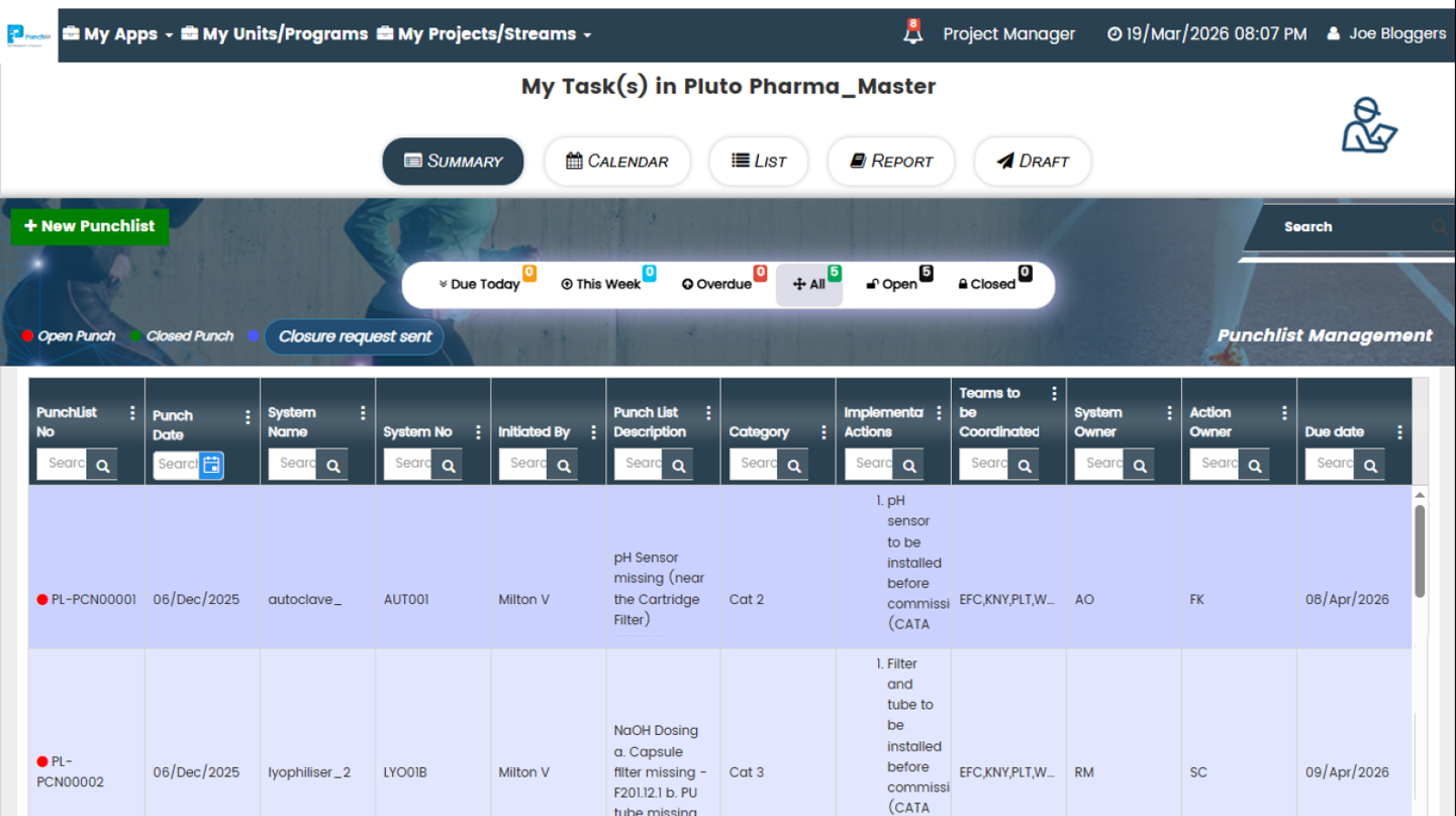
Summary View
Get a quick view of the summary of all Punchlist in the default Summary View.
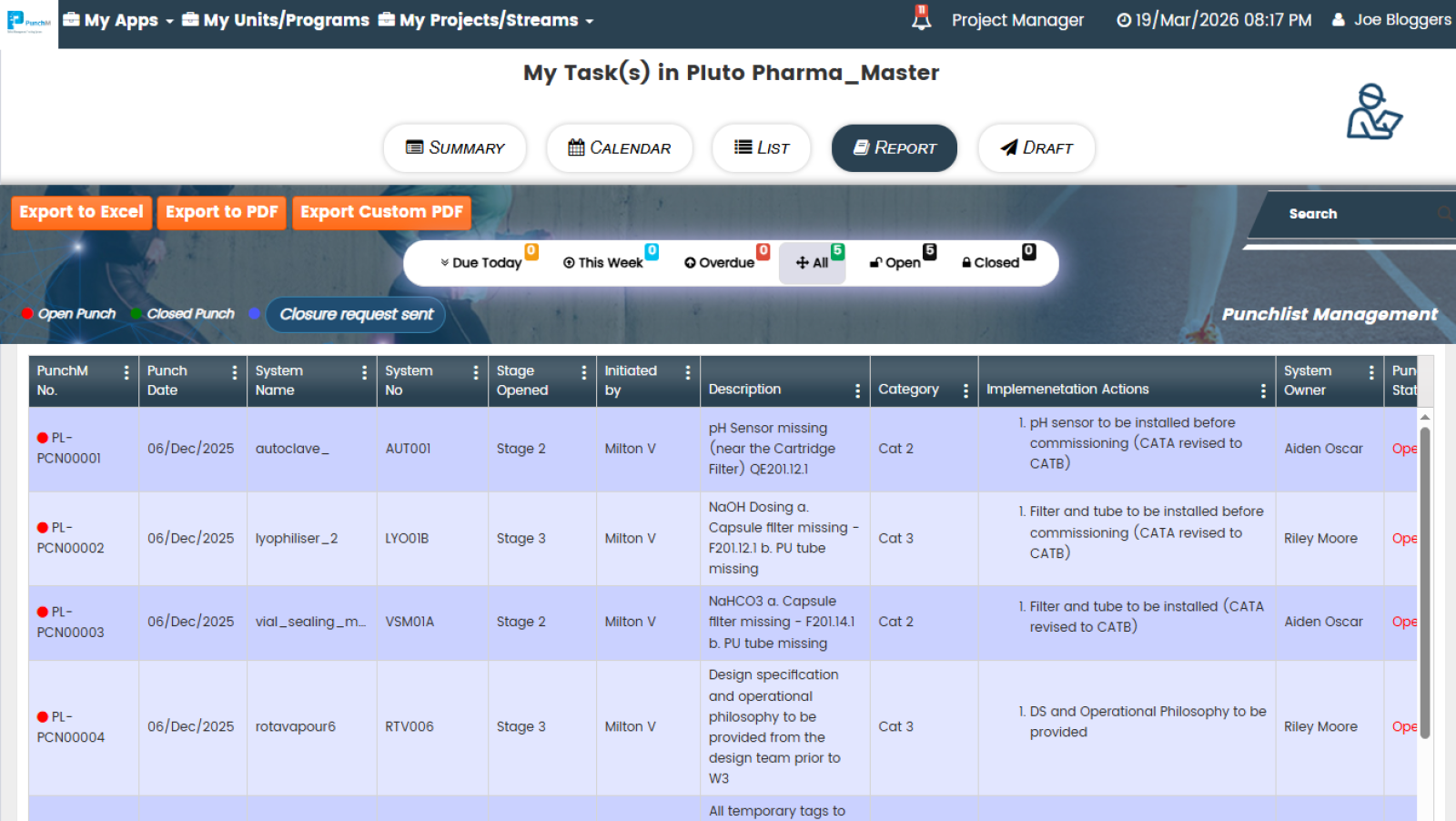
Report
Revolutionise your team’s work management with PunchM
– Centrally manage all snags, defects, issues, and punch lists.
– Categorize and define each item according to its system.
– Accessible on a scalable platform, user-friendly on both laptops and mobile devices.
– Enhance defect management process, facilitating team empowerment.
– Proactively observe unparalleled results through streamlined operations.
– Saves time, resources, and fosters increased accountability.
Built for seamless collaborative work management
Manage Multiple Teams
Assign closure actions directly to respective teams and provide details, priority and clarity
Visualise current status on dashboards
Lists defects in multiple views and achieve timely closure
Empower your Team
Help executers to self manage and proactively deliver, on-time.
Simplify Reports
In-built report builder for multiple customised reports
Manage Remote teams
Improve their teams’ effectiveness and easily manage remote teams
Maintain complete traceability
Maintain the central repository of all details for all open and closed defects
Trusted Platform
Safeguard your data from manipulation and confirm closure of defects with proof
Define Process Flow
Define collaborative workflows
Multi-lingual Selection
Options for multi language selection

Increase Productivity

Reduce Resource Cost

Increase Collaboration 24 X 7
Improve Accountability
FAQ’S (Frequently Asked Questions)
PunchM by goPLIMS is a centralised, digital Punchlist Management platform designed to raise, organise, assign, track, and close snags, defects, and punch items across every phase of a project — on a single governed platform. Unlike paper-based punch registers or shared spreadsheets, PunchM gives every team member — System Owners, Project Managers, contractors, and quality teams — live, real-time visibility of the status of every open item, from the moment it is raised to the moment it is formally closed and verified. Items are logged with full descriptions including system number, system name, priority, category, and assigned executor. Proof of work completion can be attached directly from a mobile phone on-site, and System Owner or Project Manager approval is required before any item is formally closed — eliminating the risk of premature or unverified closures that are common in paper-based systems.
PunchM is built around three core pillars that mirror the natural lifecycle of every punch item. Define: each defect, snag, or punch item is formally initiated online with a detailed description, system number and name, priority level, category classification, assigned executor, and a scheduled completion date. This replaces vague verbal instructions or handwritten notes with a structured, unambiguous record that every stakeholder can access immediately. Organise: once raised, items are tracked in real time by system, priority, status, and responsible party. System Owners and Project Managers can monitor progress, identify bottlenecks, and intervene on at-risk items without waiting for weekly site walks or manual status reports. Finish: closure is not simply a status change — it requires the executor to upload verified proof of completion for each implementation action, which is then routed to the System Owner or Project Manager for formal approval. This approval-gated closure process ensures that every closed item is genuinely resolved, traceable, and documented — a standard that paper punchlist systems consistently fail to meet.
In pharmaceutical facility projects, punchlist management is not just a construction handover task — it is a critical prerequisite for the execution of validation protocols. Before an Installation Qualification (IQ) or Operational Qualification (OQ) can commence on a system, all Category A or B punch items for that system must typically be closed and verified. PunchM directly supports this requirement by allowing punchlists to be organised by system, with items categorised by their classification (Category A, B, or C) and filtered and reported on that basis. The customised punchlist reports generated by PunchM can be used as formal evidence that all prerequisite punch items for a given system have been satisfactorily closed prior to protocol execution — supporting the traceability and documentation requirements of Good Manufacturing Practice (GMP) and regulatory expectations from the FDA, EMA, and HPRA. For Commissioning, Qualification and Validation (CQV) teams, this makes PunchM an essential tool for managing the readiness gateway between construction completion and qualification execution.
PunchM provides four views that give teams the flexibility to monitor punchlist status at the level of detail they need. Summary View is the default dashboard, displaying an at-a-glance breakdown of all punch items by status — open, in progress, pending approval, or closed — giving Project Managers an instant site readiness picture without navigating individual records. List View provides a detailed, fully sortable and filterable table of all items, organised by system, date, priority, category, or executor — ideal for system-level review meetings and formal handover readiness reports. Calendar View maps all scheduled completion dates onto a calendar, making deadline clusters and at-risk items immediately visible and enabling proactive resource planning. Draft View allows users to save incomplete punch records and return to finalise them — ensuring no item raised on-site is accidentally lost before formal submission. All views reflect live data and are accessible from both laptop and mobile devices.
In large pharma or engineering projects involving dozens or hundreds of systems, the ability to categorise and prioritise punch items is what separates manageable execution from uncontrolled chaos. PunchM allows each item to be assigned a priority level and a category at the point of creation — typically reflecting the standard industry classification of Category A (safety-critical or must-close before commissioning), Category B (must-close before handover or qualification), and Category C (non-critical, can close post-handover). Items are then organised and filterable by system number and name, so System Owners can view only the items relevant to their system, and Project Managers can generate system-level punchlist reports for handover packages, qualification readiness reviews, or contractor close-out meetings. This system-based organisation, combined with priority classification, ensures that the most critical items receive focused attention while lower-priority items are tracked and managed without being lost.
One of the most common failure points in traditional punchlist management is the gap between work being physically completed on-site and that completion being formally documented and verified. PunchM closes this gap with a mobile-accessible platform that allows executors to attach photographic or documentary proof of completion directly from their phone at the point of finishing the work — whether that is a photograph of a completed installation, a signed test certificate, a calibration record, or any other evidence of satisfactory closure. This proof is stored against the punch item record and submitted alongside the closure request for System Owner or Project Manager approval. The result is an unbroken, time-stamped chain of evidence from item creation to verified closure — with no risk of verbal confirmations being accepted in place of documented proof, and no reliance on site personnel remembering to file paperwork after the fact.
For organisations running multiple construction, commissioning, or validation projects simultaneously — across different sites, business units, or programmes — PunchM provides a centralised management layer that spans all of them from a single login. Each business unit or programme can maintain its own punchlist register with its own system structure, team access, and reporting configuration, while leadership and programme managers retain a consolidated view across all programmes to track overall readiness, resource allocation, and risk. This eliminates the fragmentation that occurs when each project maintains its own disconnected spreadsheet or paper register, making it impossible to compare progress, share resources, or report consistently upward to steering committees or client organisations. For pharmaceutical companies simultaneously managing multiple facility projects, tech transfer programmes, or validation campaigns, this multi-programme architecture is a significant operational advantage.
PunchM enforces a structured approval-gated closure process that prevents items from being marked closed without proper verification. Once an executor has completed the work and attached their proof of completion, the item is submitted for formal review and approval by the designated System Owner or Project Manager. The approver can review the uploaded evidence, add comments, request additional information, or formally approve the closure — all within the platform. If the evidence is insufficient or the work is found to be incomplete, the item is returned to the executor with documented feedback. This two-step verification process — executor submission followed by owner approval — creates a complete, auditable closure record for every punch item, satisfying the traceability requirements of both project governance and regulatory compliance. It also prevents the common problem of items being prematurely closed in spreadsheets without any verification of the actual work.
PunchM includes an in-built report builder that allows System Owners, Project Managers, and QA leads to generate tailored punchlist reports at any point during the project — sorted, filtered, and formatted to match the specific requirements of the intended recipient or milestone. For construction handover, a system completion report can show all Category A and B items raised against a system, with their closure status, executor, approver, and proof of completion — providing the contractor and owner with a formal handover record. For qualification readiness, a pre-IQ or pre-OQ punchlist report can formally document that all prerequisite punch items for a system are closed and approved, supporting the sign-off process for protocol execution. (With inbuilt data integrity, the reports can stand regulatory scrutiny) For steering committee or client reporting, a programme-level summary can show open item counts by system, priority, and age. All reports are exportable to PDF or Excel, making distribution to project teams, quality functions, and regulatory bodies straightforward.
PunchM is a core module within the goPLIMS Integrated Project Execution Platform, and it is designed to connect seamlessly with the broader suite to provide end-to-end traceability across the project lifecycle. Punch items that require formal information clarification before they can be resolved can be linked to an RFI in RFI-M. Items that arise from or generate a design or scope change can be connected to ChangeM. Documents referenced in a punch record — drawings, specifications, test certificates — can be managed and version-controlled in EDocM. Actions arising from open punch items can be tracked in ActionR to ensure nothing falls through the governance gap between site execution and project management. For CQV programmes, the closed punchlist reports generated by PunchM feed directly into the qualification readiness documentation managed across the broader goPLIMS platform. This connected architecture means that a defect raised on-site does not live in isolation — it exists within a fully traceable, governed record system that links physical execution to quality documentation, decisions, and regulatory deliverables.
Yes, PunchM supports the digitalisation of deviation and exception management by enabling teams to capture, track, and close punch items in a structured, compliant, and fully traceable system.
In pharmaceutical and regulated projects, deviations and exceptions often emerge during inspections, walkthroughs, commissioning, and validation activities. PunchM allows teams to log these issues as punch items, assign ownership, and track them through to closure within defined workflows.
Each punch item is:
- Logged with detailed descriptions, attachments, and context
- Assigned to responsible teams or individuals
- Time-stamped and tracked across its lifecycle
- Fully auditable for inspections and compliance reviews
With team-based workflows and role-based access control, PunchM ensures that sensitive data is managed securely while maintaining visibility across relevant stakeholders.
By replacing manual punch lists, spreadsheets, and email tracking, PunchM ensures that deviations are systematically managed, reducing risk, improving closure timelines, and strengthening compliance readiness.
Yes, PunchM supports knowledge management by capturing and structuring all punch items, resolutions, and observations into a centralised, reusable knowledge base.
In pharma projects, punch lists often contain critical insights related to quality issues, recurring defects, and operational gaps. PunchM ensures this information is not lost by storing all punch items, actions taken, and final resolutions in a structured format.
Over time, this enables teams to:
- Identify recurring issues and root causes
- Improve quality and execution standards in future projects
- Reuse past learnings to accelerate issue resolution
With searchable records, categorisation, and role-based dashboards, teams can easily access relevant insights while maintaining control over sensitive information.
By embedding knowledge capture into deviation and punch management workflows, PunchM helps organisations transition from reactive issue handling to proactive quality and continuous improvement—a critical capability in regulated environments.