Tacit & explicit knowledge retention
Knowledge Management
Stop critical pharma knowledge walking out the door
goPLIMS retains decisions, lessons, and institutional expertise across every programme and workstream — captured at source, searchable, and permanently governed on a dedicated pharma cloud.
Dedicated pharma cloud | Searchable across all programmes | Purpose-built for pharma
4
21 CFR
1
Critical pharma knowledge is lost between programmes, teams, and phases
Most pharma organisations still manage operational and project knowledge through emails, meeting notes, shared drives, and undocumented discussions.
As teams change and programmes evolve, valuable expertise, decisions, and lessons learned are often lost — forcing organisations to repeatedly solve the same problems.
Decisions Are Buried in Disconnected Systems
Critical decisions, discussions, and approvals are often trapped in email chains, spreadsheets, or meeting notes that are difficult to access or search.
Without structured knowledge capture, teams struggle to understand what was decided, why it was decided, and who approved it.
Knowledge Is Lost When People Leave
Experienced scientists, QA managers, and project leaders often hold critical operational knowledge that is never formally documented.
When team members move on, organisations lose valuable expertise, historical context, and programme continuity.
Lessons Learned Are Not Reused
Many organisations capture lessons learned retrospectively in static documents that are rarely revisited or integrated into future programmes.
As a result, teams repeat avoidable mistakes, duplicate effort, and reinvent solutions that already exist elsewhere in the organisation.
Knowledge Is Siloed Across Functions & Phases
Development, clinical, audit, manufacturing, and regulatory teams often manage knowledge independently with little cross-functional visibility.
This creates fragmented execution, inconsistent decision-making, and limited organisational learning across the pharma lifecycle.
goPLIMS closes the gap
goPLIMS embeds knowledge capture directly into everyday execution workflows — ensuring decisions, lessons learned, actions, and supporting documents are captured at the point of activity, not retrospectively.
A single governed platform where knowledge is searchable, traceable, retained, and continuously reused across programmes, teams, and phases.
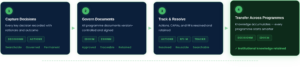
Knowledge captured at the point of action — continuously, across every programme
goPLIMS does not ask teams to capture knowledge separately. The platform captures it automatically as part of normal programme execution — decisions, document approvals, RFI responses, and action completions all retained at source and accumulating across programmes.
Real knowledge management scenarios across pharma operations
From retaining regulatory strategy decisions to capturing tech transfer expertise — goPLIMS governs the institutional knowledge that keeps pharma programmes moving when people change.
Supplier qualification
Retaining regulatory strategy decisions when the Head of Regulatory Affairs changes
A biotech company captures every regulatory strategy decision — market priority rationale, agency consultation outcomes, dossier scope choices — in DecisionM during NDA development. When the Head of RA moves on, the incoming lead inherits a complete, searchable decision record rather than a blank slate and a stack of emails to excavate.
Inspection readiness
Capturing process development knowledge when scientists retire or move to competitors
A CMC team uses goPLIMS to document formulation decisions, scale-up learnings, and manufacturing parameter rationale throughout development. When senior process scientists leave before commercial launch, the tech transfer team receives a structured, searchable knowledge record — not a tribal knowledge gap that delays CDMO onboarding.
Internal GMP programme
Applying lessons from a failed Phase II trial to the Phase III design of the backup candidate
After a Phase II efficacy miss, the lessons — patient selection criteria, endpoint sensitivity, biomarker strategy — are captured in goPLIMS. When the backup candidate programme enters Phase II, the clinical team searches and retrieves those lessons directly, informing protocol design before first patient is enrolled.
Third-party compliance
Building a searchable library of audit decisions and CAPA resolutions across annual programmes
A QA team retains every audit finding, CAPA rationale, and close-out decision in goPLIMS across consecutive annual audit programmes. When the same supplier is re-audited, auditors search prior findings and resolution history before the audit — arriving prepared rather than repeating questions already answered years before.
The goPLIMS modules powering pharma knowledge management
Six purpose-built modules that capture knowledge as a natural by-product of programme execution — on one dedicated, 21 CFR Part 11 compliant cloud with shared audit trail and document store.
ActionR
Action Register Management
Every action completed becomes part of the programme knowledge record — who resolved it, what was done, and when. Patterns of corrective action across programmes become visible and reusable.
EDocM
Electronic Document Management
A single governed repository for all programme documents across every phase — version-controlled, searchable, and permanently retained. Every document is linked to the team and programme that created it.
ESignM
Electronic Signature Management
Every document, decision, and approval is signed with a 21 CFR Part 11 compliant e-signature — timestamped and tamper-evident. The knowledge record is not just retained; it is authenticated and legally defensible.
RFI-M
RFI Management
Every query and response — from CROs, CDMOs, regulatory agencies, or internal teams — is retained as a governed knowledge record. Future programmes inherit a library of resolved questions, not a fresh queue of unknowns.
TrackR
Central Online Tracker
A live dashboard of knowledge-critical milestones and decision points across all programmes — making visible when knowledge capture needs to happen, not just when a programme ends.
DecisionM
Decision Management
Capture every programme decision with rationale, alternatives considered, and outcome. Searchable across all programmes and phases — institutional knowledge retained in the platform permanently, not in people’s heads.
Every knowledge record governed, authenticated, and permanently retained
Knowledge in goPLIMS is not just stored — it is governed. Every decision, document, and resolved action is backed by a compliant electronic record that is traceable, tamper-evident, and exportable for inspection at any time.
Authenticated knowledge records
Every decision, document approval, and action resolution is signed with a 21 CFR Part 11 compliant e-signature — so the knowledge record carries proof of who captured it, when, and with what intent.
Immutable audit trail on every record
Every create, update, and access event on a knowledge record — decision, document, or action — is captured in an immutable, timestamped audit trail. The trail cannot be deleted or altered, and is exportable for inspection on demand.
Role-based access control
Knowledge records are accessible only to those with appropriate role permissions. Cross-programme search is available to authorised users without exposing confidential programme data to those without the relevant access.
Dedicated single-tenant pharma cloud
Your pharma knowledge — decisions, documents, lessons learned — is never co-mingled with other companies or industries. A dedicated instance with dedicated storage and access controls meeting GMP data security requirements.
Permanent retention and backup
Knowledge records are retained permanently — not subject to auto-deletion or archive policies that create gaps. Automated backup and recovery procedures ensure all knowledge remains available meeting GMP data availability requirements.
ALCOA+ enforced at capture
All knowledge records are Attributable, Legible, Contemporaneous, Original, and Accurate — enforced by the platform at the point of capture, not by user process. What is captured cannot be unattributed, backdated, or altered.
From live knowledge gaps to a complete cross-programme decision library
goPLIMS makes institutional knowledge visible and measurable — not just accumulated passively in a system no one checks. These reports tell you what you know, what is at risk, and what the next programme can build on.
Decision Register Export
Cross-Programme Knowledge Dashboard
Lessons Learned Summary
Document Repository Index
Knowledge Retention Score
Programme Handover Knowledge Pack
Compliance without the enterprise price tag
goPLIMS was designed from the ground up for regulated pharma — not adapted from a generic knowledge management tool. Small and mid-size teams get enterprise-grade knowledge governance without the complexity or cost.
Single dedicated cloud
Your pharma knowledge is never shared with other industries or tenants. A dedicated deployment meeting GMP data integrity and data security requirements throughout.
21 CFR Part 11 by design
Every knowledge record — document, decision, or action — is backed by a compliant electronic record and audit trail. Knowledge is not just stored; it is governed and authenticated.
One integrated platform
Knowledge captured during audits, pre-manufacturing phases, and regulatory submissions all lives on the same platform — searchable together, not siloed by programme type or team.
Live in days, not months
Configure your programme structure and your team begins capturing and retaining knowledge from day one — with onboarding support included and no lengthy implementation project.
Your questions answered.
Knowledge capture in goPLIMS is embedded into normal programme execution — not a separate process. When a team member completes an action, resolves a query, or approves a document, the platform records it. When a decision is made in DecisionM, the rationale is captured as part of the decision workflow. There is no separate “capture knowledge” task because the platform does it at source, automatically.
Yes. goPLIMS retains decisions, documents, and completed actions across all programmes in one searchable platform. When a new tech transfer or regulatory submission begins, the team can search for related decisions, prior RFI responses, and lessons from previous programmes — without having to track down who was on that team or where they saved the files.
Because goPLIMS captures decisions, document approvals, and action resolutions at the point of execution, the knowledge is in the platform rather than in the individual. When someone leaves, their decisions remain in DecisionM with full rationale, their document approvals remain in EDocM with e-signature records, and their completed actions remain in ActionR with resolution details. The institutional knowledge does not leave with them.
Yes. Knowledge management is a capability built into every module across all four pharma segments. Decisions captured during a clinical trial are searchable alongside decisions made during a regulatory submission or an audit. The platform accumulates institutional knowledge across your entire pharma operation, not just within a single programme type.
Ready to stop critical pharma knowledge walking out the door?
See how goPLIMS captures tacit and explicit knowledge across all your pharma programmes — governed, searchable, and permanently retained on a dedicated pharma cloud.