From Audit Observations to Verified Closure
How goPLIMS uses ActionR as the central remediation index to manage every audit observation, sub-action, timeline, evidence record, and closure endorsement.
An audit observation is not closed when it is recorded. It is closed when every associated remediation action, change, deviation, punchlist, RFI, decision, evidence record, approval, & endorsement can be traced back to the original finding. goPLIMS enables that traceability by using ActionR as the central index.

Internal audits, supplier audits, regulatory inspection readiness reviews, and external audits all generate lists of observations, gaps, recommendations, and required corrective actions. The audit team may provide a clear list of areas to remediate, but after the audit concludes, ownership typically moves back to operational, engineering, quality, validation, manufacturing, or project teams.
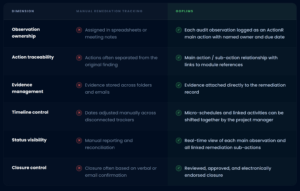
This is where many organisations lose control. Observations are copied into spreadsheets. Actions are discussed in email threads. Evidence is stored in shared folders. Closure status is updated manually. The auditors move on, the remediation team gets busy, and the organisation is left without a single reliable trace of whether every observation was remediated, verified, and closed satisfactorily.
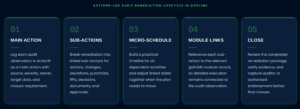
goPLIMS changes the audit remediation model from a static list into a controlled execution structure. Each audit observation can be logged as a main action in ActionR, with all remediation work broken down into linked sub-actions and referenced to the relevant goPLIMS modules. The result is one governed thread from audit finding to verified closure.
Audit Remediation Is an Execution Process, Not a Spreadsheet
The output of an audit is often a list. But remediation is not a list-management exercise. It is a cross-functional execution process that must demonstrate accountability, sequencing, progress, evidence, review, and closure.
goPLIMS structures that execution through ActionR, the Action Register module. ActionR becomes the index for the whole remediation list: each audit observation is created as a main action, and every remediation activity required to address that observation is created as a linked sub-action.
A single observation may require several different workstreams: a procedural update, a change control, a deviation or discrepancy review, a punchlist item, an RFI, a decision record, training evidence, document revision, or validation impact assessment. In ActionR, these become visible child activities under the main observation, with references to the relevant goPLIMS modules where the detailed workflow is managed.
ActionR provides the remediation spine. The original audit finding, main action, linked sub-actions, module references, owners, due dates, micro-schedules, evidence, approvals, and closure endorsement remain connected within one integrated platform.
This matters because remediation is only meaningful when it is verifiable. If an auditor returns six months later and asks how Observation 14 was closed, the answer should not require searching emails, folders, meeting notes, and personal trackers. It should be immediately retrievable as a complete main-action record, with every sub-action and module reference visible in context.
The Traceability Gap After the Audit Team Moves On
Audit teams are excellent at identifying gaps. Their role is to assess, report, and challenge the organisation to improve. But they are not always positioned to manage the daily execution of remediation after the audit has concluded.
Once the audit team moves on, the remediation burden shifts to the business. Without a controlled platform, the organisation must rely on informal follow-up: status meetings, manual trackers, reminders, and individual discipline. This creates a familiar set of risks:
- Observations are closed administratively before the corrective action is fully effective.
- Evidence is collected but not linked directly to the originating finding.
- Owners change roles and knowledge is lost.
- Due dates are extended without a clear approval trail.
- Auditor verification is captured in email rather than as a controlled endorsement.
- Senior leaders lack real-time visibility of overdue or high-risk remediation items.
goPLIMS provides continuity. The audit team may initiate or provide the list of observations, but ActionR keeps every item alive as a main action until its linked sub-actions have been completed, evidenced, reviewed, and closed in a traceable manner. Project managers can view the total remediation timeline, manage dependencies, and move connected activities to a later date when the plan changes without losing control of the original observation.
“The audit may end, but the obligation to remediate remains. goPLIMS keeps that obligation visible, owned, and traceable until every observation is satisfactorily closed.”
ActionR as the Remediation Index for Every Audit Observation
Audit findings rarely fall neatly into one functional box. A data integrity observation may require document updates, training records, system access changes, procedural clarification, and quality approval. A facility readiness observation may require engineering action, punchlist closure, commissioning evidence, and validation review.
In goPLIMS, ActionR acts as the master index for this work. Every audit observation is created as a main action. The different remediation activities required to close that observation are created as sub-actions, each with ownership, due dates, dependencies, micro-schedule visibility, and a reference to the relevant execution module.
This gives the project manager a single control point. The main action represents the audit observation. The sub-actions represent the remediation plan. The linked module references provide the detailed execution evidence. If the remediation timeline changes, connected activities can be moved together, preserving the relationship between the observation, the plan, and the revised schedule.
ActionR
DiscrepM
ChangeM
TrackR
RFI-M
DecisionM
EDocM
ESignM
FormM
PunchM
The benefit is not simply that goPLIMS has multiple modules. The benefit is that ActionR provides the parent-child structure that ties those modules together. A finding can be logged as a main action in ActionR, broken into sub-actions, linked to ChangeM for a controlled change, DiscrepM for a deviation or investigation, PunchM for field closure, RFI-M for clarifications, DecisionM for governance decisions, EDocM for revised records, FormM for evidence capture, and ESignM for final endorsement. The remediation story remains complete from beginning to end.
Micro-Schedule Control for Complex Remediation Plans
Audit remediation is rarely a single-step activity. One observation may require a sequence of dependent tasks: assessment, decision, change approval, implementation, document update, training, verification, and closure. If any upstream activity moves, downstream dates must be adjusted in a controlled way.
ActionR supports this by allowing teams to create a practical micro-schedule under the main audit observation. Sub-actions can be linked to the timeline of the main action, making it easier for project managers to understand the real critical path of remediation rather than managing isolated due dates.
Linked remediation planning reduces schedule fragmentation. When the project manager needs to move activities to a later date, linked ActionR activities can be moved together, preserving schedule logic and keeping the overall remediation plan aligned with the revised target closure date.
This is especially useful when remediation spans multiple departments or depends on external inputs. Instead of manually adjusting dates in several trackers, goPLIMS keeps the audit observation, sub-actions, module references, and closure timeline aligned in one platform.
Closure That Auditors Can Endorse
The strongest remediation programmes distinguish between action completion and observation closure. Completing an action does not always mean the audit concern has been fully resolved. The closure decision should confirm that the implemented remediation addresses the original finding, that the evidence is sufficient, and that the residual risk is acceptable.
goPLIMS enables structured closure review at the main action level. Remediation owners can propose closure only when the relevant sub-actions, module records, evidence, approvals, and implementation outcomes are complete. Quality can review the full package, and auditors or authorised reviewers can endorse that the original observation has been satisfactorily addressed. This creates a defensible record of closure rather than an informal status update.
Auditor endorsement becomes part of the controlled record. Closure is not hidden in an email thread. It is captured as a governed review step, with attribution, timestamp, supporting evidence, and electronic approval where required.
This is particularly valuable for repeat audits, regulatory follow-up, inspection readiness, management review, and site governance. The organisation can demonstrate not only that individual actions were completed, but that the parent audit observation was fully addressed through all linked remediation activities and formally accepted for closure.
Real-Time Oversight Across All Audit Remediation Work
Audit remediation often spans multiple departments, programmes, vendors, and sites. Senior leaders need visibility into what is open, what is overdue, what is high risk, and what is awaiting review. Manual reporting cannot provide this reliably without continuous reconciliation.
goPLIMS gives leadership a live view of remediation progress. Observations can be filtered by audit source, severity, department, responsible owner, due date, workflow status, closure stage, and the status of linked sub-actions. Escalations can be managed before deadlines are missed, and teams can focus attention on items that present the highest compliance or operational risk.
This makes audit remediation a managed portfolio rather than a collection of disconnected follow-up actions. It also supports a stronger governance rhythm: remediation review meetings can focus on main observations, overdue sub-actions, module-level blockers, schedule changes, decisions, and risk rather than debating which spreadsheet is current.
From Findings to Confidence
Audit observations are valuable because they identify where the organisation must improve. But that value is only realised when each observation is remediated effectively, evidenced clearly, reviewed appropriately, and closed with confidence.
Spreadsheets can record a list. Emails can request updates. Shared folders can store evidence. But none of these create a controlled, traceable, integrated remediation process. In regulated environments, that distinction matters.
goPLIMS provides the cloud-based integrated execution platform to manage audit remediation from initial observation through ActionR main action, linked sub-actions, module execution, micro-schedule control, evidence review, auditor endorsement, and final closure. It keeps every finding visible, every owner accountable, every activity connected, and every closure defensible.
For organisations that want audit remediation to be more than a follow-up exercise, goPLIMS provides the structure to turn findings into verified improvement.
Audit Remediation | Observation Closure | ActionR Main Actions | Sub-Action Traceability | Inspection Readiness | Evidence Management
| Quality Governance | Micro-Schedule Control | Integrated Execution

About goPLIMS
goPLIMS is an Integrated Project Execution & Management Platform — delivering real-time visibility, workflow governance, and compliance-ready execution across the entire project lifecycle. Purpose-built for pharma and regulated industries, goPLIMS reduces coordination time by up to 50%, helping teams accelerate speed to market.
DOWNLOAD PDF
Make Audit Remediation Traceable
Book a personalised demonstration and explore how goPLIMS can use ActionR to manage audit observations as main actions with linked remediation sub-actions, evidence, module references, and auditor-endorsed closure.