Pre-Manufacturing Phases Knowledge Management in Pharma
How integrated knowledge management across Product Development, Tech Transfer, Clinical Trials, and Project Management can eliminate the silent threat of knowledge leakage — and turn every project into lasting organisational intelligence.
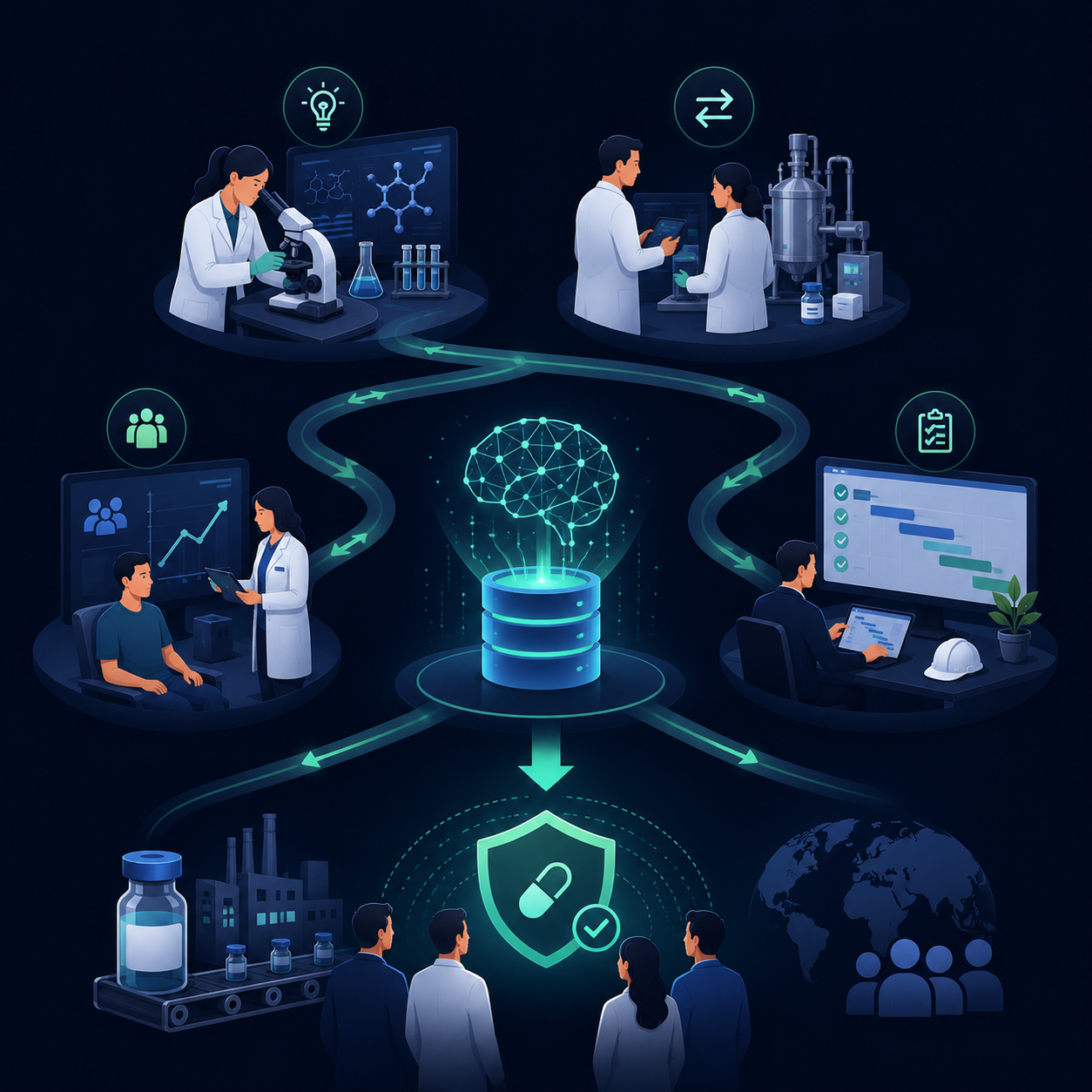
In the pharmaceutical industry, knowledge is not merely a by-product of work — it is the work. Every experiment conducted, every formulation tested, every clinical outcome observed carries strategic value that extends far beyond the immediate project. Yet in most organisations, this knowledge quietly evaporates at every phase boundary.
The pre-manufacturing lifecycle — spanning Product Development, Technology Transfer, Clinical Trials, and Project Management — is arguably the most knowledge-intensive stretch of any drug’s journey to market. Decisions made in these phases shape regulatory submissions, manufacturing scale-up, commercial viability, and ultimately, patient outcomes.
The challenge? These phases are also where knowledge is most fragile. Siloed systems, transient teams, external partnerships, and relentless time pressure conspire to ensure that hard-won insights are never formally captured. When the project ends, the knowledge walks out the door.
This article explores why knowledge management in pharma pre-manufacturing phases is a strategic imperative — and how a purpose-built integrated platform like goPLIMS transforms project execution into a permanently growing body of organisational intelligence.
The Four Pre-Manufacturing Phases — and Why Each One Matters
Before diving into the knowledge management challenge, it’s worth mapping the terrain. The pre-manufacturing lifecycle in pharma comprises four interconnected, sequentially dependent phases, each generating its own body of critical knowledge.
Product Development
The genesis of everything. Scientists explore formulation options, conduct feasibility studies, evaluate API properties, and establish proof-of-concept. The knowledge generated here — failed experiments, unexpected observations, formulation decisions and their rationale — is dense and often entirely undocumented beyond individual lab notebooks.
Project Management
Overarching project decisions — scope changes, resource adjustments, risk escalations, supplier negotiations — are made continuously. These decisions and their context are typically buried in email threads, meeting minutes, or the memory of individual project managers. When a project team changes or a programme restarts, this institutional history is almost entirely lost.
Technology Transfer
Knowledge must cross organisational or functional boundaries — from R&D to manufacturing, or from an innovator to a CMO. This is perhaps the single most knowledge-vulnerable moment in the lifecycle. Tacit knowledge that lived in the heads of development scientists rarely survives the handover intact.
Clinical Trials
Phase I through III trials generate enormous volumes of safety, efficacy, & pharmacokinetic data. But alongside the formal data packages, a parallel body of operational knowledge accumulates: site performance insights, patient recruitment strategies, protocol deviation learnings, & vendor management experience that is rarely formalised for future use.
Each phase feeds directly into the next. Knowledge loss at any transition is cumulative — the further downstream a programme reaches without structured knowledge transfer, the more it must re-learn, re-test, and re-decide. In regulated industries, this re-work is not just costly; it delays patients’ access to medicines.
The Knowledge Management Challenge in Pre-Manufacturing
Pharmaceutical organisations have invested heavily in quality management systems, electronic lab notebooks, and document management platforms. Yet knowledge leakage remains a persistent, industry-wide problem. Why?
The answer lies not in the volume of tools, but in the fundamental mismatch between how knowledge is generated and how it is captured. Knowledge in pre-manufacturing phases is predominantly tacit — experiential, contextual, and human. It emerges from conversations in corridors, from the intuition of a formulation scientist who has seen a similar challenge before, from a project manager who knows which vendor will struggle under pressure.
The most valuable pharmaceutical knowledge is not in the data package — it’s in the reasoning behind every decision that shaped it. And that reasoning is almost never written down.
— Industry Observation, Pharmaceutical Knowledge Management
Standard document management captures outputs. It almost never captures the process, the rationale, the failed alternatives, or the qualifications and caveats that make an output truly usable by the next team.
The consequences are significant and concrete. Regulatory submissions that lack clear decision rationale attract agency queries. Manufacturing scale-ups that didn’t properly absorb technology transfer knowledge lead to batch failures. Clinical programme restarts that couldn’t access prior learnings repeat costly protocol mistakes. Each incident is traceable, at least in part, to a knowledge management failure.
47%
3×
60%
Why Knowledge Leaks — The Four Root Causes
Understanding the root causes of knowledge leakage is the prerequisite for solving it. In pre-manufacturing pharma environments, four structural issues drive the vast majority of knowledge loss.
Tacit Knowledge in External Hands
CROs, CMOs, specialist consultants, and academic collaborators hold deep contextual knowledge about a programme. When the engagement ends, that knowledge is gone. There is no standard mechanism for internalising what external p
Fragmented, Disconnected Systems
The average pharma organisation uses a patchwork of systems — ELN, LIMS, document management, email, SharePoint, vendor portals — that were never designed to communicate with each other. Knowledge lives in isolation, undiscoverable and unconnectable.
Phase Gates as Milestones
In most organisations, phase gate reviews focus on whether criteria are met to proceed. They are milestone events, not knowledge transfer events. The rich context that should flow from one phase to the next is simply not on the agenda — and so it doesn’t happen.
Time Pressure and Documentation Debt
Pharmaceutical development operates under intense time pressure. Documentation is consistently deferred in favour of execution. By the time a team returns to capture knowledge, the context has faded, team members have moved on, and the moment of learning has passed.
What Effective Knowledge Management Looks Like Across Each Phase
Solving the knowledge management challenge in pre-manufacturing requires more than a better filing system. It requires an approach that embeds knowledge capture into the work itself — not as an administrative burden layered on top, but as a natural part of how teams operate.
Across each of the four phases, this translates into distinct but interconnected practices:
1 – During Product Development
Structured experimental templates that capture not just results but hypotheses, rationale for design choices, and interpretations of unexpected outcomes. Decision trees and learning summaries that remain searchable and linked to downstream development decisions.
2 – During Technology Transfer
A formal, structured knowledge transfer protocol that requires the originating team to articulate tacit knowledge — known risks, process sensitivities, equipment quirks, supplier insights — before a programme transitions. Not a document checklist, but an active knowledge elicitation process.
3 – During Clinical Trials
Operational knowledge capture that runs in parallel with the formal data collection — site intelligence, investigator performance, protocol lessons, vendor insights — stored in a structured, retrievable form that can directly inform the design of the next study.
4 – During Project Management
Decision logging that captures not just what was decided, but why — the alternatives considered, the risks weighed, the assumptions made. A searchable project history that survives team changes and programme pauses.
Leading organisations are shifting from “knowledge management” as a retrospective activity to “knowledge capture at the point of work” — embedding structured learning moments into daily workflows, sprint reviews, and experimental cycles. This dramatically increases the quality and completeness of the knowledge retained.
How goPLIMS Delivers Integrated Knowledge Management
goPLIMS was designed from the ground up to address the specific knowledge management challenges of pharmaceutical pre-manufacturing. It is not a document management system with a KM label applied — it is a purpose-built integrated project execution platform that treats knowledge as a first-class asset across every phase.
One Integrated Project Platform
A single connected environment spanning all four pre-manufacturing phases — eliminating the fragmentation that causes knowledge to fall between system cracks.
Knowledge Capture at the Point of Work
Structured templates and intelligent prompts embedded directly into daily workflows — ensuring knowledge is captured as it’s created, not retrospectively.
Formal Phase Gate Handovers
Mandated, structured knowledge transfer events built into every phase transition — ensuring that tacit and explicit knowledge flows forward, not just milestone approvals.
Compliance-Ready Knowledge Trails
All knowledge capture and transfer activities generate audit-ready records, directly supporting ICH Q10 compliance and regulatory submissions with clear decision traceability.
Controlled Collaborator Access
External collaborators can access and contribute to the knowledge base within tightly controlled, fully auditable boundaries, capturing external tacit knowledge rather than losing it.
Searchable Organisational Memory
Every decision, experiment, outcome, and handover becomes permanently searchable — turning project history into a living knowledge asset that future teams can directly build upon.
The Strategic Value: From Projects to Organisational Intelligence
The true return on investment in pharmaceutical knowledge management extends far beyond any single project. When knowledge is systematically captured across all pre-manufacturing phases, a compounding benefit begins to emerge: the organisation becomes genuinely smarter with every programme it runs.
New programmes inherit the lessons of prior ones — not through informal hallway conversations, but through searchable, structured, validated knowledge assets. Formulation scientists can query what approaches failed in analogous molecules. Tech transfer teams can draw on detailed records of previous scale-up challenges. Clinical operations can build on site intelligence accumulated across multiple studies.
The goal is not to manage knowledge as a compliance obligation. The goal is to make every new pharmaceutical programme faster, lower-risk, and more cost-effective by standing on the shoulders of every programme that came before it.
— goPLIMS Platform Philosophy
This is the difference between a pharmaceutical organisation that completes projects and one that builds capability. The former finishes each programme and moves on; the latter finishes each programme and is measurably better at the next one.
In an industry where the average drug development cost exceeds $1 billion and timelines stretch across a decade, the compounding value of structured knowledge management is not marginal — it is potentially one of the most significant competitive differentiators available.
From Knowledge Leakage to Knowledge Leadership
The pre-manufacturing phases of pharmaceutical development are not simply a sequence of technical activities. They are a sustained process of learning — learning about molecules, about processes, about systems, about partners, about organisations. The tragedy of knowledge leakage is not just that knowledge is lost; it is that the same learning must be repeated, at great cost, over and over again.
The organisations that will lead the next generation of pharmaceutical development are those that treat knowledge as the strategic asset it truly is. Not as a documentation burden, not as a compliance requirement, but as the accumulated intelligence of every scientist, project manager, clinical operations professional, and external partner who has contributed to their programmes.
goPLIMS was built to make that ambition a practical reality — providing a single, integrated platform where knowledge is captured naturally, transferred formally, and made permanently accessible across every pre-manufacturing phase.
The transformation from project execution to organisational knowledge is not an aspiration. With the right platform, it is an operational outcome.

About goPLIMS
goPLIMS is an Integrated Project Execution & Management Platform — delivering real-time visibility, workflow governance, and compliance-ready execution across the entire project lifecycle. Purpose-built for pharma and regulated industries, goPLIMS reduces coordination time by up to 50%, helping teams accelerate speed to market.
DOWNLOAD PDF
See goPLIMS in Action
Discover how goPLIMS integrates knowledge management across all pre-manufacturing phases in a live platform walkthrough.